

Many business owners in Kuwait and the GCC spend money on ads every month, tracking clicks and impressions closely. But when they try to figure out where that budget actually went in terms of real business results, they often can’t find a clear answer.
The problem here usually isn’t the quality of the ad itself. It’s that the ad is operating in isolation — disconnected from the content that supports it, disconnected from tracking, and disconnected from any system that follows up with the customer after they engage. The result: budget gets spent, engagement happens, but real, measurable growth doesn’t materialize.
That’s exactly the difference between running "an ad" and running an integrated marketing system — what’s known as a Marketing Operating System.
Why Isn’t a Good Ad Enough on Its Own?
An ad’s core job is to capture attention. It delivers your message to a wider audience and encourages the people who see it to engage — by visiting your page, following your account, or reaching out for the first time.
But after that moment, there are questions an ad alone can’t answer:
- Was the content the audience saw after clicking the ad actually convincing enough?
- Is there accurate tracking that shows which ad drove a real result and which one didn’t?
- If someone engaged and showed interest but didn’t buy right away, who follows up with them afterward?
- Are future decisions based on real data, or on guesswork?
Without clear answers to these questions, the ad keeps operating in isolation from the rest of the process, and any positive result becomes closer to luck than to a repeatable, scalable system.
What Is a Marketing Operating System?
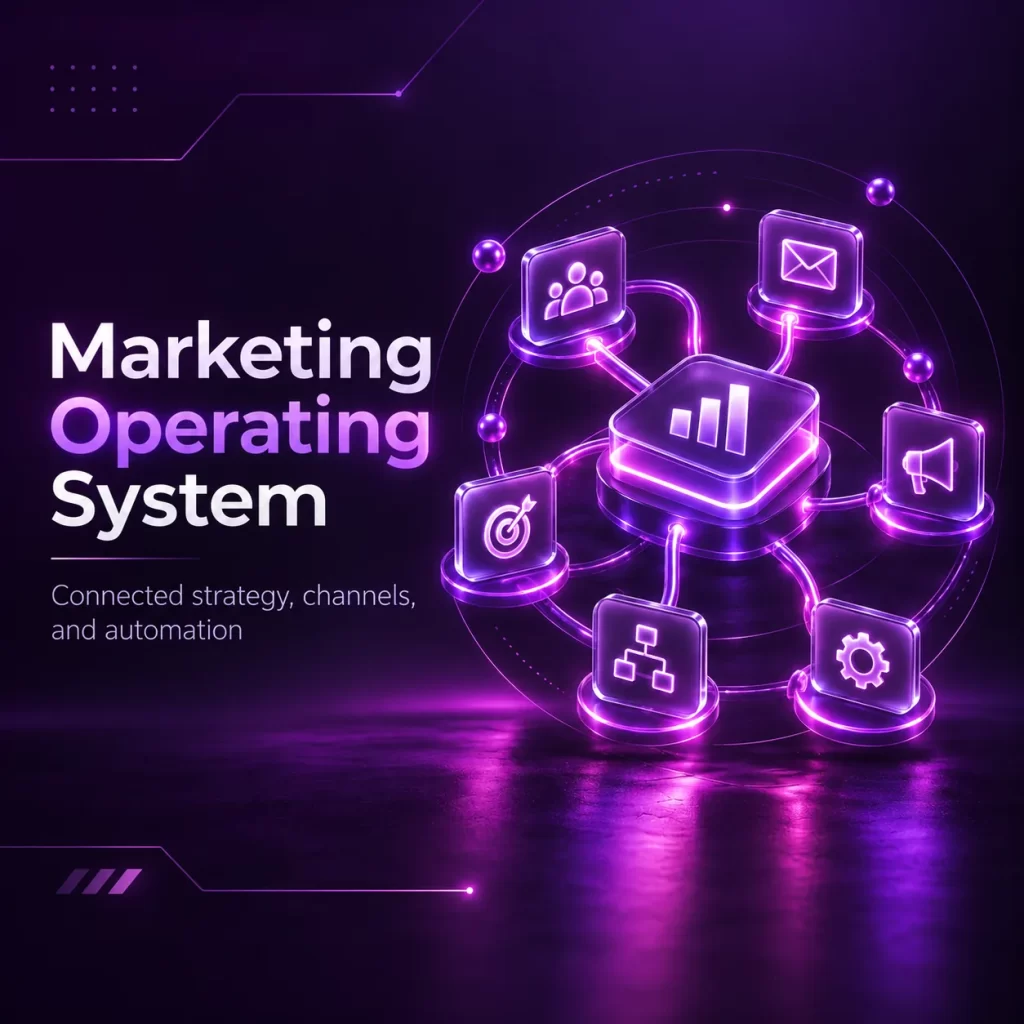
A Marketing Operating System is the way every part of marketing — strategy, content, paid advertising, follow-up and automation, and tracking and analysis — works together as one connected system, instead of each piece operating on its own in isolation from the rest.
Put simply: instead of asking "how do I create a better ad?", the right question becomes "how do I build a system where every dinar spent on marketing has a clear path from that first moment of attention all the way to an actual purchase decision?"
The Difference Between a Traditional Ad Agency and an Integrated System
A traditional ad agency usually focuses on one piece: managing the ad campaign — targeting, budget, and basic reports on clicks and impressions.
An integrated marketing system looks at the bigger picture. The ad campaign is part of a larger system, connected to content that supports it, tracking that measures its impact accurately, and a follow-up system that turns engagement into an actual customer. And measurement here isn’t just "how many people saw the ad?" — it’s whether that ad actually contributed to a business result the owner can measure, a concept covered in more depth in our guide to Performance Marketing.
It’s important to clarify that a Marketing Operating System isn’t a single piece of software or an off-the-shelf tool you buy and install. It’s an operational approach to organizing marketing as one connected system. This approach may include tools like a CRM, WhatsApp automation, Meta Pixel, GA4, and various ad platforms — but the real value doesn’t come from any single tool. It comes from connecting strategy, content, advertising, tracking, automation, and reporting together within one system.
The Six Components of an Integrated Marketing System
The complete system is built on six connected elements, each one supporting the others:
1. Strategy
Always the starting point: who is your actual target audience? What problem does your product or service solve for them? Which channel best fits this audience? Without clear answers to these questions, any ad or piece of content is just a guess.
2. Content
Content is what convinces the audience before they buy. Images, video, and the ad copy itself are all forms of content, and their quality makes a direct difference between an ad the audience engages with and one that passes by without any impact. Why content separates successful ads from failed ones is explained in our guide to content marketing.
3. Paid Media
This is the channel that delivers your message to the largest possible audience, quickly. Choosing the right platform (Meta, Google, TikTok, Snapchat, or LinkedIn) depends on the nature of your business and your audience — a topic covered in detail in our guide to digital advertising in Kuwait.
4. Follow-Up and Automation (Marketing Automation)
Most businesses lose potential customers not because of the ad itself, but because of a lack of fast, organized follow-up afterward. A follow-up system through WhatsApp or a CRM helps reduce the loss of important interactions and makes follow-up faster and more organized. This aspect is covered in detail in our guide to Marketing Automation.
5. Tracking and Analytics
Without accurate tracking, there’s no clear way to know which ad or channel actually delivered a result. Tools like Meta Pixel, Meta CAPI, and GA4 are what provide these answers — details are available in our digital marketing measurement guide.
6. Continuous Optimization
The system isn’t something you build once and then leave alone. The data that tracking provides is used continuously to adjust targeting, improve content, and reallocate budget toward what’s actually delivering results.
How Do These Components Work Together? A Practical Example
Imagine a potential customer watching an ad on Instagram for a restaurant, a clinic, or an online store:
- The ad — built on a clear strategy for a specific audience — grabs their attention.
- They click it and land on a page or piece of content that clearly explains the offer.
- Tracking (Pixel/CAPI) records this interaction accurately, even if they don’t complete a purchase right away.
- If they don’t complete the purchase, the automation system sends a WhatsApp follow-up or a reminder message.
- The collected data goes back to the team, who identify which ad drove the most actual engagement and adjust targeting and budget accordingly.
This complete loop — from that first moment of attention to the decision itself, then continuous optimization — is the essence of a Marketing Operating System. Each step supports the one that follows, and every piece of data is used to improve what came before it.
Why Do Businesses in Kuwait and the GCC Need This Approach Specifically?
The Kuwait and GCC market has characteristics that make this approach especially necessary:
- High competition for the same audience: Many businesses (restaurants, clinics, online stores) compete for the same customer segment across the same platforms, so any improvement in targeting or follow-up makes a real difference.
- Expectation of a fast response: Customers in the region are used to quick communication over WhatsApp, and any delay in responding after an ad can mean losing the opportunity to a faster competitor.
- Ad cost is affected by system quality: Without accurate tracking and continuous optimization, it can become harder to understand — or improve — the cost of reaching a customer over time.
- Purchase decisions pass through multiple touchpoints: Customers rarely buy from the first ad they see. Organized follow-up is what turns initial interest into an actual decision.
Signs Your Marketing System Is Incomplete
There are clear signals that your marketing is operating as separate pieces rather than one connected system:
- You’re spending on ads continuously, but you don’t know exactly which campaign generated most of your sales.
- Potential customers reach out via WhatsApp or a contact form, but there’s no clear system following up with them in an organized way.
- There’s no accurate tracking (Pixel, CAPI, or GA4) showing the source of every sale or genuine inquiry.
- Your content changes from one ad to the next without a clear plan or direction.
- Every marketing decision is based on impression or past experience, not on actual measured data.
If any of these signs apply to your situation, it’s an indicator that your advertising is operating alone, without the rest of the system that’s supposed to support it.
How to Start Building an Integrated Marketing System for Your Business
Building the system doesn’t happen in one step, but there’s a logical order most successful business owners follow:
- Start with strategic clarity: Define your target audience and your actual business goal before increasing your ad budget.
- Connect content to your ads: Make sure every ad leads to content or a landing page that completes the same message, not to a generic, unrelated page.
- Activate accurate tracking first: Before increasing your budget, make sure you have tracking that actually shows you what’s working and what isn’t.
- Build an automated follow-up system: Even if it’s simple, make sure every potential customer gets a fast, organized response.
- Review the data continuously: Set aside regular time to review actual performance and adjust targeting and content based on it, not on guesswork.
These steps don’t guarantee a specific outcome on their own, but they build the right foundation that makes any future marketing effort more effective and clearer to measure.
Frequently Asked Questions
Is a Marketing Operating System the same as social media management?
No. Social media management is one part of the system (within content), but the complete system also includes strategy, advertising, tracking, and follow-up — and all of them work together.
Is a Marketing Operating System a piece of software or a technical platform?
No. A Marketing Operating System isn’t a single piece of software — it’s a way of organizing marketing as a connected system. It may use tools like a CRM, WhatsApp automation, Meta Pixel, GA4, or ad platforms, but the goal is connecting these tools within a clear system that serves growth, measurement, and follow-up.
Is this approach only suitable for large companies?
No, the same principle applies to any size of business. The difference is only in the size and complexity of each component — a small business needs a simple follow-up system via WhatsApp, while a larger company might need a fully integrated CRM. What shapes the budget at that smaller scale is covered in our guide to how much digital marketing costs for a small business in Kuwait.
Do I need to switch agencies to apply this approach?
Not necessarily. The more important point is that the team or agency you work with looks at marketing as one integrated system, not as separate services with no connection between them.
How long does it take to build an integrated system?
It depends on your current situation. If you already have tracking or a follow-up system in place, the next step is faster. If you’re starting from scratch, it’s better to build the components gradually and in a logical order, rather than trying to implement everything at once.
Where do I start if this is the first time I’m hearing about this concept?
The best place to start is an honest assessment of your current situation — a marketing audit: Do you have accurate tracking? Is there a follow-up system for potential customers? The answers to these questions show you exactly where to begin.
Ready to Talk to Zain Media?
Zain Media is a digital marketing agency based in Kuwait, founded in 2015.
If your business is running ads continuously but the results aren’t clear, Zain Media can help you review your entire marketing system — from strategy and content to tracking, follow-up, and campaign performance — to pinpoint exactly where the gap is.