




Many businesses in Kuwait and the GCC review their campaign reports and find good numbers: high clicks, plenty of views, new followers. But when you ask a simple question — "how many actual customers did this campaign bring in?" — the clear answer disappears.
That exact gap is what the concept of Performance Marketing addresses.
What Is Performance Marketing?
Performance Marketing is a marketing approach that measures the success of any marketing effort based on real, measurable business outcomes — leads, sales, or any predefined goal — rather than general metrics like views or likes.
The core idea is simple: every dinar spent on marketing should be traceable to a clear result. If you can’t tell what a specific campaign actually achieved, it’s difficult to judge its success or improve it later.
This approach works best when it’s part of an integrated marketing system that connects strategy, content, advertising, tracking, and follow-up together, as explained in our guide to what a Marketing Operating System is.
The Difference Between Performance Marketing and Traditional Marketing
Traditional marketing (like TV ads or billboards) usually focuses on reach and exposure: how many people saw the ad? How many times did it appear? These are important metrics for building a brand over the long term, but they don’t precisely show the ad’s impact on actual sales.
Performance Marketing differs on a fundamental point: every element of a campaign — from targeting to the ad message to the page the audience lands on — can be measured, analyzed, and adjusted based on real data. This doesn’t mean brand-building isn’t important; it means there’s an added layer of measurement and accountability that helps business owners understand the impact of their marketing spend more clearly.
Why Aren’t Clicks, Views, and Followers Enough?
These metrics are sometimes called "vanity metrics" because they look positive on the surface but don’t necessarily reflect a business outcome.
- A high number of views might just mean the ad reached a wide audience, without meaning that audience is genuinely interested in the service or product.
- An increase in followers doesn’t necessarily mean an increase in sales or inquiries.
- A high number of clicks might indicate passing curiosity more than genuine purchase intent.
What matters more than these numbers is what happens next: did this engagement turn into real contact? Did it end in a sale? That’s exactly what real performance metrics answer.
The Most Important KPIs in Performance Marketing
Leads
The number of people who showed genuine interest in the service or product — through a contact form, a WhatsApp message, or a phone call. This metric reflects real interest, far beyond a simple click or view.
Sales
The ultimate goal of most campaigns: the number of actual sales that resulted from the marketing effort, whether directly online or through later follow-up.
Cost Per Lead (CPL)
The amount a campaign spends for each individual lead. This metric helps you understand a campaign’s efficiency at attracting genuine interest, and allows you to compare the performance of different campaigns on a common basis.
Cost Per Acquisition (CPA)
The amount a campaign spends for each actual customer (not just someone interested). This metric is more precise than CPL because it measures the final outcome, not just an intermediate step in the customer’s journey.
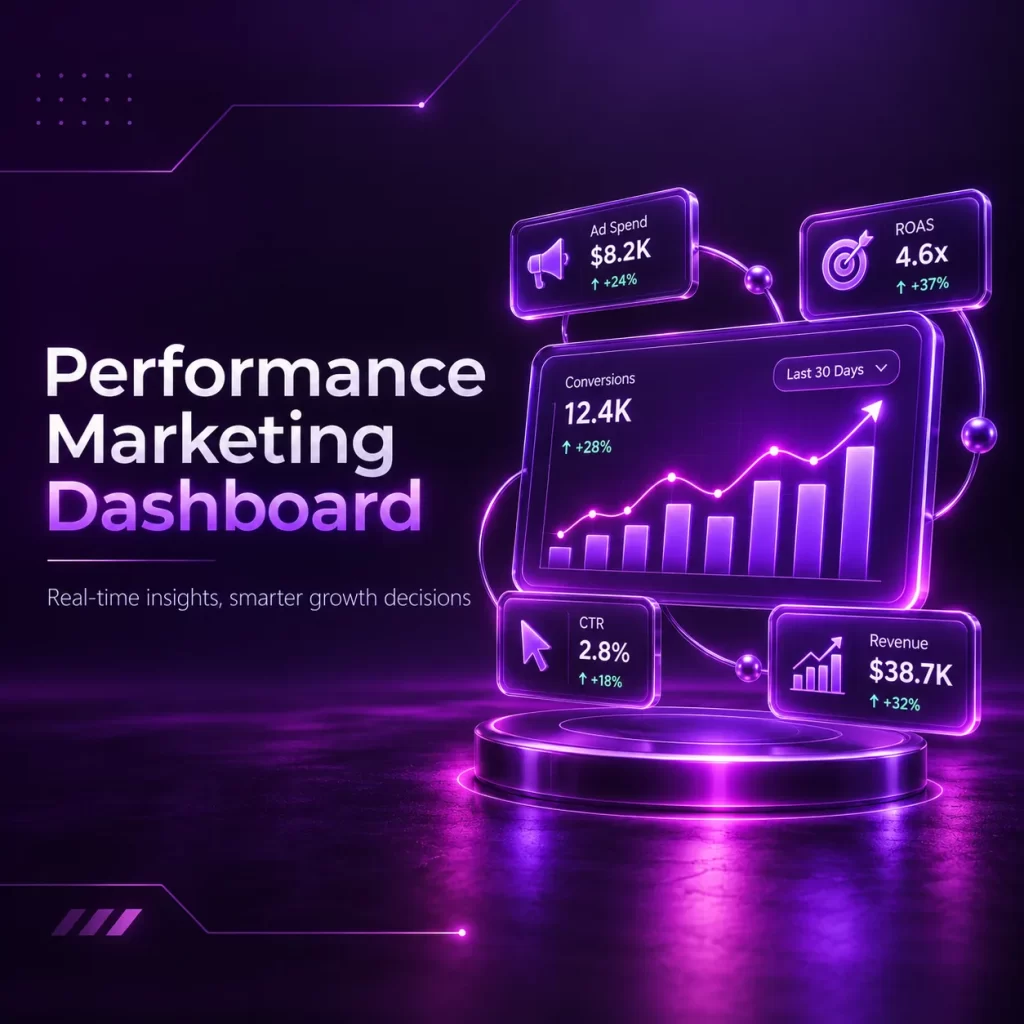
Return on Ad Spend (ROAS)
This metric shows the return a business achieves for every dinar spent on advertising. Understanding this number accurately requires correct tracking of sales and their source — a topic covered in detail in our digital marketing measurement guide.
Conversion Rate
The percentage of people who took the desired action (purchase, sign-up, contact) out of everyone who engaged with the ad or visited the page. A low conversion rate might point to a problem with the ad message, the landing page, or how well-matched the target audience is.
Why Is Tracking Essential?
Without accurate tracking, none of these metrics can be known reliably. Where did this customer come from? Which ad or platform actually contributed to the purchase decision? These questions are answered by a proper tracking system — a concept known as attribution.
Without this layer of measurement, marketing decisions become based on guesswork rather than real data, and it becomes difficult to know which part of the budget is delivering real results and which isn’t. Details on this — from Meta Pixel to GA4 — are covered in our digital marketing measurement guide.
How Does Continuous Optimization Work?
Optimization is the ongoing process of reviewing a campaign’s performance and adjusting it based on real data — not a step you do once at launch.
This usually includes: testing more than one ad version to see which performs better (sometimes known as A/B testing), adjusting targeting based on the segment that actually responds, and reallocating budget toward what delivers the best return. This process takes time and enough data, and doesn’t necessarily mean immediate results from the first test.
Why Is Performance Affected by Creative, Targeting, the Landing Page, and Follow-Up Together?
A common mistake is looking at performance as the responsibility of a single element, like the ad itself. In reality, any campaign’s performance is affected by several connected elements:
- Creative (the ad’s creative content): Are the message and design compelling enough to attract the target segment?
- Targeting accuracy: Is the ad actually reaching the audience closest to a purchase decision?
- The landing page or website: Is the experience after the click smooth and clear, or does the visitor struggle to complete the desired action?
- Follow-up speed: Even with an excellent campaign, a lack of fast, organized follow-up with leads can cost the business real opportunities that were close to converting into sales — a subject covered in detail in our guide to Marketing Automation.
Weakness in any one of these elements affects the final result, even if the ads themselves are managed carefully.
An Example from Kuwait and the GCC
Imagine a cosmetic clinic in Kuwait running an ad campaign for a specific service. View counts are high, clicks are good, but actual bookings are low.
Applying Performance Marketing logic, the question doesn’t stop at "is the ad good?" — it extends to: is the booking page clear and easy? Are WhatsApp inquiries answered quickly enough? Is the target audience actually the people searching for this specific service?
In many cases, the reason for weak results is a point other than the ad itself — and that’s exactly what accurate performance measurement reveals, instead of simply watching view counts.
Common Mistakes When Evaluating Campaign Performance
- Judging success from a single metric only, like click count, without looking at what happened afterward.
- Comparing campaigns without unifying measurement standards, such as comparing an awareness campaign to a direct-sales campaign.
- Evaluating performance over too short a period, before there’s enough data for a reliable decision.
- Ignoring what happens after the click, like landing page quality or the speed of following up with leads.
- Lack of accurate tracking, which makes evaluating any campaign based on general impression rather than real data.
How Does Performance Marketing Fit Within Zain Media’s Operating System?
Performance Marketing isn’t a standalone service — it’s a layer of measurement and accountability that spans every element of the marketing system: the strategy that defines the goal, the content that persuades, the ads that deliver the message, the follow-up that turns interest into a customer, and the tracking that measures all of it accurately.
When choosing the right ad platform for this approach — whether Meta, Google, or others — the decision depends on the nature of your business and audience, a separate topic covered in our guide to digital advertising in Kuwait. But the core idea in this article stays constant: real success isn’t measured by engagement alone, but by a business outcome that can be measured and built upon.
Frequently Asked Questions
Does Performance Marketing only mean Meta and Google ads?
No. Performance Marketing is a general concept that can be applied to any ad platform, as long as there’s clear measurement of results. Choosing the right platform is a completely separate topic.
Does Performance Marketing guarantee better results for certain?
No. This approach doesn’t guarantee a specific outcome, but it provides greater clarity about what’s working and what isn’t, making it possible to improve performance over time more precisely than relying on guesswork.
What’s the difference between ROAS and CPA?
ROAS measures overall return against ad spend, while CPA measures the cost of acquiring one actual customer. Both are useful, but they answer two different questions about campaign performance.
How long does it take to reliably evaluate campaign performance?
It depends on the campaign’s size and the nature of the business, but judging performance after too short a time or too few interactions can lead to inaccurate conclusions.
Do small businesses actually need to apply this approach?
Yes — the principle isn’t tied to company size but to clarity of goal and measurement. Even campaigns with limited budgets benefit from knowing which part of them is delivering a real result.
Ready to Talk to Zain Media?
Zain Media is a digital marketing agency based in Kuwait, founded in 2015.
If your business runs ad campaigns but it’s hard to connect spending to a clear business outcome, Zain Media can help you review your entire performance system — from strategy and tracking to campaign optimization and lead follow-up.